ServicesReverse Osmosis
Under-Sink Reverse Osmosis in Pinellas Park
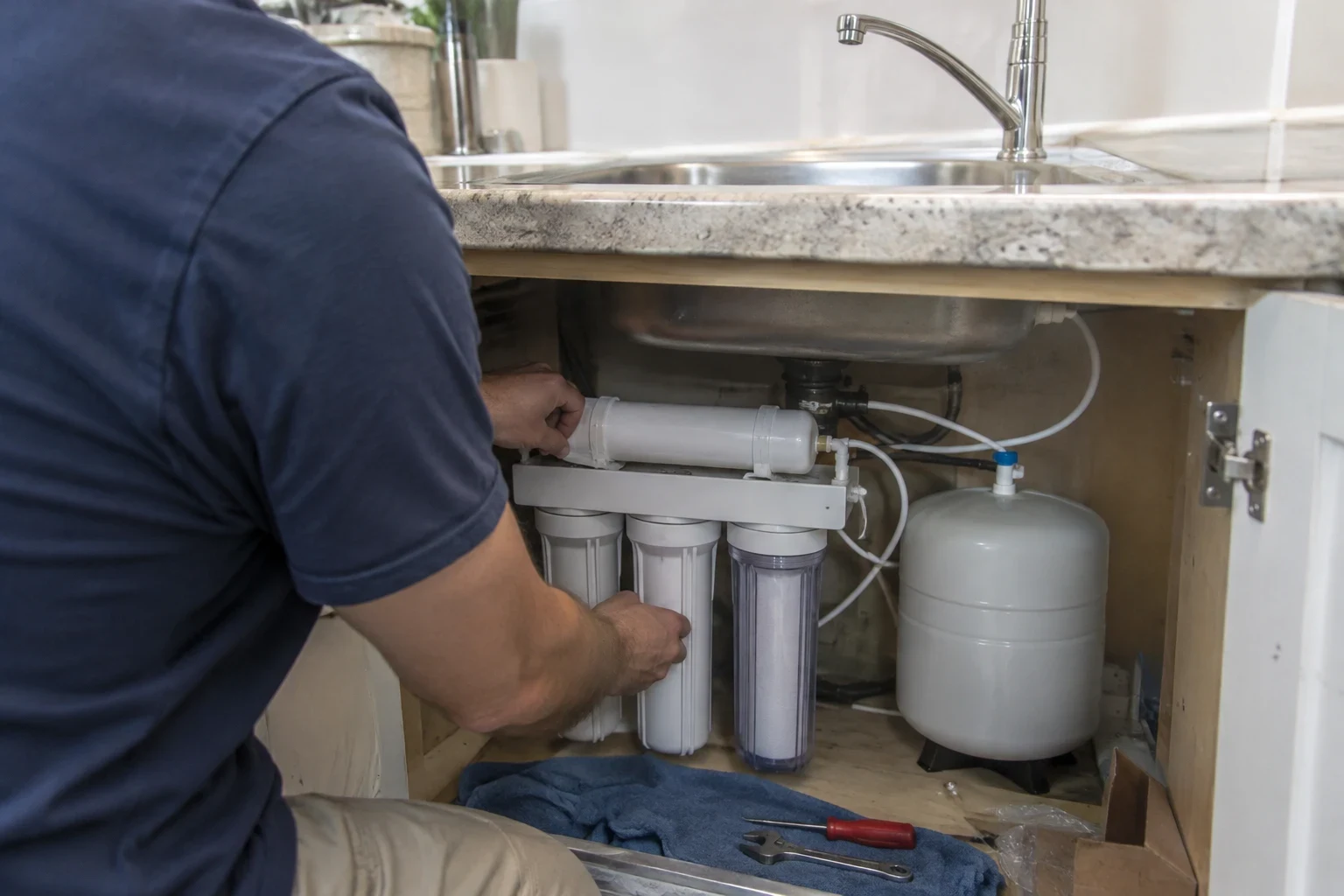
Our under-sink reverse osmosis setups route kitchen water through a sediment cartridge, a carbon block and a thin-film membrane, then deliver it to a faucet of its own. Before we open the cabinet we cover your floors, and we tell you what each fitting does as it goes in.
How a membrane cleans your drinking water
In reverse osmosis, household pressure forces water across a semipermeable membrane whose pores are fine enough to hold back most dissolved solids. That includes sodium, nitrates, fluoride, and lead that can come off old solder joints or brass fixtures. The carbon cartridges upstream remove chlorine taste and smell, and they shield the membrane too, since chlorine slowly degrades thin-film material.
An RO unit serves a single point of use, typically the kitchen sink, with an optional line to the refrigerator ice maker. Showers and the washing machine are outside its job. If you want treated water at every tap in your home, look at whole-home filtration or chlorine and chloramine removal; plenty of households run one of those and add RO at the kitchen.
What comes with an RO installation
Sediment and carbon prefilters
A sediment cartridge catches sand, pipe scale and rust flakes first. A carbon block follows to remove chlorine. Where a utility disinfects with chloramine, we specify catalytic carbon, since standard carbon removes chloramine slowly and lets it reach the membrane.
Thin-film composite membrane
This is the stage that does the heavy lifting on dissolved solids. We size the membrane to how much water your household drinks and cooks with, so the tank refills in a reasonable time.
Storage tank or tankless unit
A traditional system uses a bladder tank pre-charged with air to push water to the faucet. Tankless units save cabinet space but need an outlet under the sink. We go over both with you before ordering anything.
Dedicated faucet and drain connection
The faucet mounts through an existing sprayer or soap dispenser hole, or a new hole in the sink deck or countertop. Reject water runs to a drain saddle on the sink drain above the trap, with an air-gap faucet where it is required.
Shutoffs, check valve and leak checks
We tee off the cold angle stop, add an automatic shutoff valve and a check valve, and test every push-fit connection under pressure before we call it done.
When an under-sink RO system makes sense
Kitchen water smells of chlorine
A swimming-pool taste at the sink is the complaint we hear more than any other. An RO unit's carbon stages remove it from the water you drink and cook with.
Bottled water fills your pantry
Stacks of cases and regular store runs add up. Treated water from a faucet under your own sink takes their place.
Chalky film in the kettle or coffee maker
That white residue is mineral content left behind when water boils off. Because RO cuts total dissolved solids, anything that heats water builds scale more slowly.
Plumbing with brass fittings or old solder
Lead solder was banned from drinking water plumbing in 1986, and older brass can still contain lead. A membrane adds one more barrier at the faucet you drink from.
An existing RO unit has slowed down
A trickle at the faucet, a tank that never fills or flat-tasting water usually means a clogged membrane, a failed tank bladder or cartridges past their life. See our water softener and filtration system replacement page if your unit is ready to retire.
What happens on install day
- 1
We talk through your kitchen by phone
You tell us about the sink, the cabinet space, open faucet holes, the countertop material and whether the fridge should be connected. With that, we load the right parts and bits, which keeps our time in your kitchen short.
- 2
Covering floors and the cabinet
A drop cloth goes down along our path to the kitchen, and towels line the cabinet base. We mark the faucet location and get your okay before any drilling.
- 3
Installing the plumbing
With the cold supply off, we fit the tee adapter and the drain saddle, then fasten the filter manifold to the cabinet wall. The tank goes where it stays clear of your trash bin and cleaning supplies, and each tube is trimmed to length rather than coiled.
- 4
Flushing and handoff
New cartridges are flushed to clear carbon fines, the first full tank is dumped, and every joint gets a second look for seepage. Before we leave, we walk you through a cartridge change and the location of the feed valve, wipe the cabinet clean and take our packaging with us.
Factors behind your RO quote
Reverse osmosis has no one-size price, since every kitchen and every household's water use is different. On the phone we lay out the choices, and you get a clear quote before we touch your plumbing. These are the things that push the figure up or down.
- Equipment configuration
- The number of stages, a tank or tankless design, and extras such as a remineralization cartridge or a UV lamp each change what the hardware costs.
- Sink deck and countertop
- An open sprayer or soap dispenser hole keeps things simple. Granite and quartz call for a diamond core bit and extra time, and a stainless sink is drilled with different tooling than a composite one.
- Ice maker line
- Sending treated water to the refrigerator adds tubing, fittings and install time. A fridge on the opposite wall needs a longer run, routed through base cabinets or along the toe kick, so distance shows up in the quote.
- Incoming pressure
- A membrane performs poorly when supply pressure drops below about 40 psi. In that case a booster pump may be needed, and it requires an electrical outlet in the cabinet.
Common reverse osmosis questions
Something not covered here? (727) 649-8906
How much water goes to the drain with RO?
A membrane needs a steady flush of reject water to stay clear. Some older systems discharge several gallons for each gallon of drinking water. A high-efficiency membrane, healthy supply pressure and a permeate pump shrink that ratio a good deal, and we can explain each option on the phone.
Will RO take out the minerals in my water?
Yes. The membrane holds back calcium and magnesium along with the other dissolved solids. For most people, food is a much bigger source of those minerals than tap water. Anyone who misses a bit of mineral character in the glass can add a remineralization stage downstream of the membrane to return a small amount.
How often should cartridges and the membrane be replaced?
Plan on new sediment and carbon cartridges roughly every six to twelve months, and a new membrane every two to three years, with heavier use shortening both. We provide ongoing customer support for maintenance, filter replacements and service needs, so you are not left guessing when a change is due.
Do you have to drill my granite countertop?
Not unless you choose that. An existing sprayer or soap dispenser hole often works for the RO faucet. When a new hole is needed, we cut it with a water-cooled diamond core bit after you approve the exact location.
What if I find a drip under the sink later?
Your RO installation is covered by our 1-year installation workmanship warranty. Close the feed valve we pointed out during the walkthrough, then phone us and we will come back to fix it.
Cleaner water at the kitchen sink, with your kitchen left as we found it
Describe your sink, your cabinet and what bothers you about the water now, and we will lay out which RO configuration suits it and how the installation goes. Before we come out, you will know where we plan to drill, mount and run tubing.